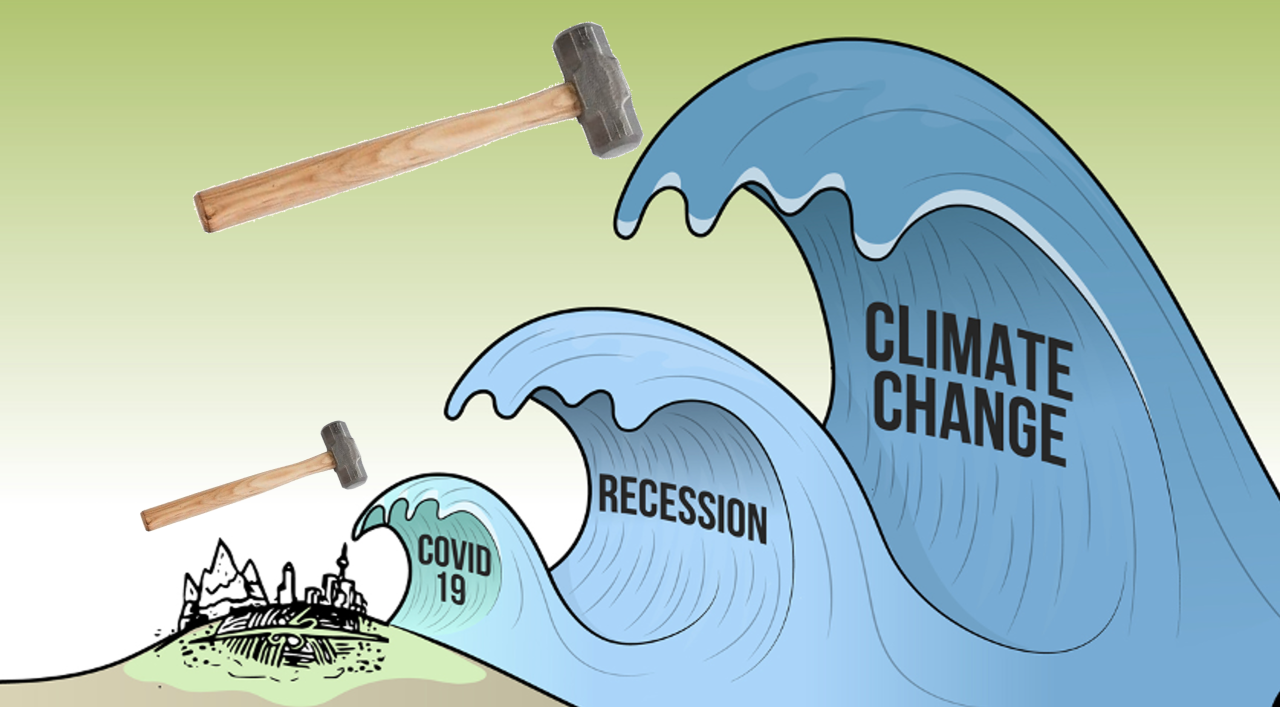
The Covid-19 crisis forced governments to take radical actions to save the life of millions of people.
Governments struggle to solve this issue, but they put all their resources and power in motion to get quick results. Personal freedom and rights have been suspended in order to gain time and save the maximum number of lives. Complete parts of the economy have been shut down, and a tremendous amount of capital has been allocated to this crisis.
I feel sad for all people impacted by this crisis: whether losing loved ones, being isolated, feeling depressed and lonely, or dealing with a terrible financial situation (business goes bankrupt, loss of employment, poverty, etc.).
I am very impressed by the collective efforts made to solve this problem quickly. Accepting for a limited period negative personal impacts for the greater good of the community is very inspiring.
The Covid-19 crisis shows what we can achieve when working together towards a given goal. All countries and governments work together with solidarity to address a threat to our species. Isn't it Mankind at its best?
Climate Change is reported in 2021 as the number one risk by the World Economic Forum
It even tops the pandemic risk! But it seems difficult for Governments to take radical actions against this 'invisible' threat. Countries are falling short of the commitments they took as part of the Paris Agreement five years ago. Most of them now have very long-term goals (2040 or 2050), and the risk for them not delivering on the CO2 savings we need is still very high. Governments seem to delay important decisions while we are already running out of time.
What would it look like if governments were tackling Climate Change with the same urgency and intensity as Covid-19?
What if governments around the world would use similar playbooks as the ones created for the pandemic? Let's imagine what the world would look like in a kind of docufiction:
- Governments would share clear indicators about Climate Change and the problems we face, holding monthly press conferences. These numbers would be easily understood and accessible by everyone per department, region, state, country.
- Temporary closure of the top 10 CO2 emitting infrastructures until GHG emissions reduction plan communicated and approved.
- Ban of sales of new ICE cars by 2024.
- Ban of gas for HVAC in new homes by 2024.
- Ban of sales of non-energy efficient appliances by 2023 (can sell only highly energy-efficient equipment).
- Closure of all coal plants and gas peaker plants by 2026.
- Carbon reporting mandatory for all companies with more than EUR 10Mln turnover by 2024.
Governments would define Economic support packages to address the Climate Change crisis
- Subsidies package for Renewable Energy & Storage infrastructures.
- Subsidies package for Electrification program (homes, buildings, cars, planes).
- Green Electricity check for a household with electric HVAC with low income.
- National Education program for electricians, energy and HVAC specialists, carbon accountants.
- Mandatory Carbon taxes by 2025.
Governments would communicate monthly KPIs used to track progress per department, region, country
- Energy / Carbon efficiency: Kwh / CO2-eq per habitat per day.
- Electrification rate (share of electricity in total final energy consumption).
- Decarbonization rate of electricity (shares of renewables and nuclear energy in the total electricity production, g of CO2-eq per Kwh)
- Electrification rate of personal mobility: km by ICE vehicles vs. km by electric vehicles, number of ICE cars vs. electric cars.
Governments would maintain a list of their on-going mitigation actions per department, region, state, country
- Net present GHG savings potential of current approved and financed mitigation actions.
- Renewable Energy & Energy storage capacity permitted.
- Renewable Energy & Energy storage capacity under construction to go on-line this month
- Renewable Energy & Energy storage capacity under construction to go on-line this year
- Renewable Energy & Energy storage capacity under construction to go on-line in the next five years
- EV charging infrastructure readiness: number of charging points, number of superchargers
- Ratio ICE vs. Electric for the new vehicles
Governments would communicate the list of super-GHG-emitters and force them to report progress on their transition monthly.
- GHG 500: global top 500 GHG emitters watchlist
- Taksforces with Automotive industry association, Airline industry association, Shipping industry association, ICT industry association, Cement industry association
Governments would take legal actions against individuals, businesses, and countries working against the Paris Agreement targets.
- Governments would impose an embargo against countries not aligned with the Paris agreement to avoid "Carbon paradises".
- Governments would seize rooftop spaces able to accommodate more than 1MWp of solar rooftop but not in use after 2023 and offer them to solar developers.
Medias would provide programs to educate us along the journey
- Maps with hot spots of GHG emissions
- Report on key indicators per department, region, countries
- Showcase energy transition success stories
Surprisingly, the impacts of these measures on the population seem limited compared to the current ones addressing the pandemic.
Personal freedom is indeed much less impacted. People could still live a 'normal' life.
These actions would also trigger a 5th industrial revolution.All sectors of the economy would have to reinvent themselves to become more carbon efficient.
I believe it is what a GREEN RECOVERY could be.