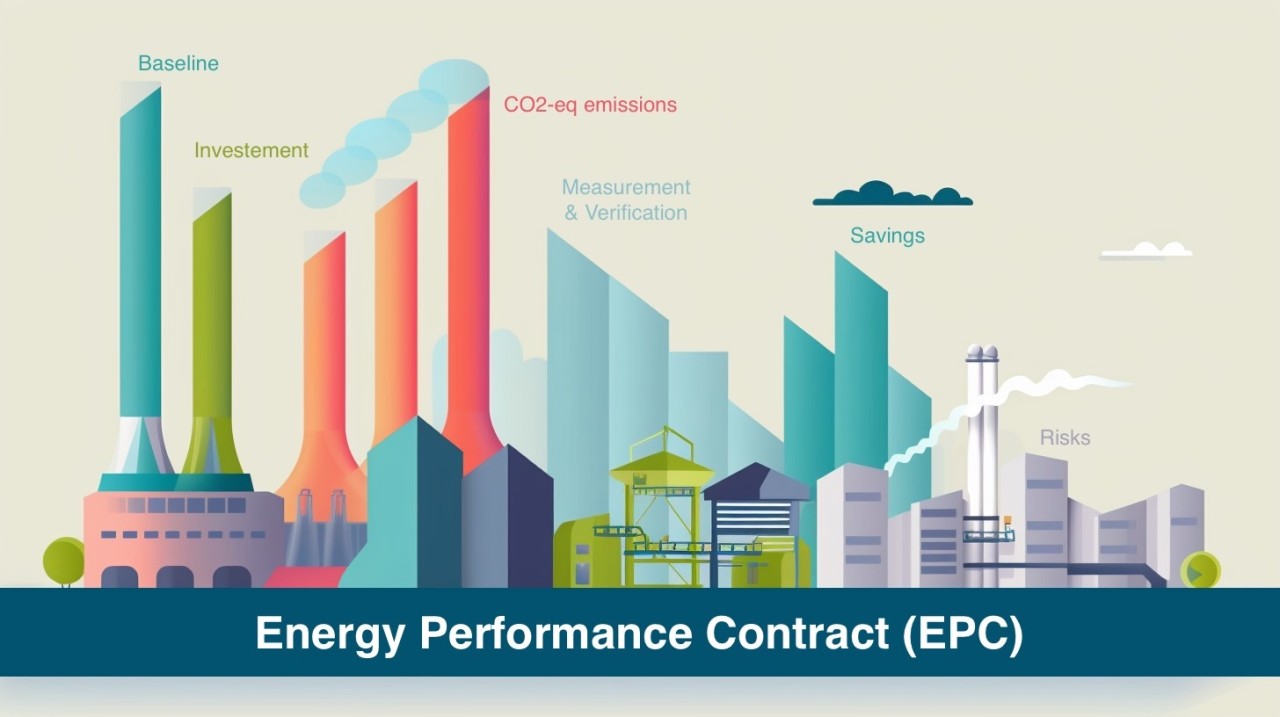
An Energy Performance Contract (EPC) is a contractual agreement that guarantees energy savings and operational improvements in a facility or industrial process through the implementation of energy efficiency measures.
The three main ways to decarbonize our economy in the coming years are:
- Electrification,
- Renewable Energy and Energy Storage,
- Energy/Carbon Efficiency.
Energy Performance Contracts (EPCs) play a key role in financing Carbon/Energy Efficiency projects.
Energy Performance Contracts are commonly associated with projects in buildings or facilities, such as energy efficiency retrofits, building automation systems, lighting upgrades, HVAC system improvements, and renewable energy installations.EPCs can also be applied to industrial processes, focusing on optimizing energy efficiency, reducing waste, and improving overall operational performance. Examples of industrial process projects under EPCs include equipment upgrades, process optimization, waste heat recovery, cogeneration systems, and renewable energy integration.
In my last article, I discussed the Do's and Don'ts for Power Purchase Agreements (PPAs). PPAs are important instruments for the electrification process and renewable energy growth. Many people are familiar with PPAs, so let's explore the specificities and similarities of these contracts with EPCs.
What is an Energy Performance Contract?
An EPC is a contractual agreement between an energy service company (ESCO) and a client, where the ESCO agrees to design, implement, and finance energy efficiency measures to achieve specified energy savings targets.
In an EPC, the ESCO typically assumes financial responsibility for implementing the energy efficiency measures, including the upfront investment, and receives compensation based on the achieved energy savings or a predetermined payment structure.
Revenue in an EPC is derived from the cost savings achieved through reduced energy consumption and operational expenses resulting from the implemented energy efficiency measures.
The performance of an EPC is measured based on the achieved energy savings compared to a baseline or historical consumption data, as well as adherence to the agreed-upon energy efficiency targets and performance indicators.
Comparison with PPAs
Both EPCs and PPAs are typically long-term contractual agreements, often spanning several years, to ensure a stable and predictable relationship between the involved parties.
Both agreements involve some degree of risk-sharing between the parties. In PPAs, risks related to project performance, electricity price fluctuations, and market conditions are typically allocated between the project developer and the off-taker. In EPCs, risks associated with energy savings performance, project implementation, and maintenance are shared between the ESCO and the client.
Both agreements can provide financial benefits to the parties involved. PPAs allow project developers to secure long-term revenue streams and attract financing for renewable energy projects. EPCs enable clients to reduce energy costs, improve operational efficiency, and enhance the value and marketability of their facilities. EPCs also allow ESCOs to secure financing for energy efficiency projects.
Baseline Considerations in EPCs
In Energy Performance Contracts, the definition and determination of the baseline is a critical aspect that can pose challenges. The baseline serves as a reference point against which the energy savings achieved through the implemented energy efficiency measures are measured.
Here are 5 key considerations related to the baseline in EPCs:
- Establishing the baseline: The baseline represents the energy consumption or performance of the facility or system before the energy efficiency measures are implemented. It should be established using historical data, measurements, or modeling techniques.
- Data availability and quality: Accurate and comprehensive data on energy consumption, operating hours, weather conditions, and occupancy levels are essential for establishing a robust baseline.
- Adjustments: Factors like changes in occupancy, production levels, or weather conditions may impact energy usage, requiring normalization techniques to establish a more accurate baseline.
- Measurement and Verification (M&V): M&V protocols ensure accurate measurement of savings through ongoing monitoring, data collection, and reporting.
- Standardization and Guidelines: Standards like the International Performance Measurement and Verification Protocol (IPMVP) provide best practices for baseline determination and M&V in EPCs.
Establishing the baseline should involve collaboration and agreement between the ESCO and the client. Clear communication on baseline methodology, data sources, and assumptions is essential to avoid disputes.
Leasing Contracts as a Framework for EPCs and PPAs
Establishing the baseline should involve collaboration and agreement between the ESCO and the client. Clear communication, understanding, and consensus on the baseline methodology, data sources, adjustments, and assumptions are essential to avoid disputes or misunderstandings throughout the contract duration. It's important to address the baseline determination challenges upfront and establish a robust methodology that considers the specific characteristics and complexities of the facility or system undergoing energy efficiency improvements. This helps ensure accurate measurement of energy savings and the fair evaluation of the success of the EPC.
Leasing contracts for equipment can serve as a valuable framework for implementing both Power Purchase Agreements (PPAs) and Energy Performance Contracts (EPCs). In the context of PPAs, equipment leasing allows renewable energy developers or providers to install and maintain energy generation systems, such as solar panels or wind turbines, on the customer's premises. The customer benefits from accessing clean energy without upfront costs, while the provider retains ownership of the equipment and sells the generated energy to the customer at an agreed-upon price. Similarly, in EPCs, leasing arrangements can facilitate the deployment of energy-efficient equipment or technologies. The lessor assumes responsibility for the upfront investment and installation, while the lessee pays for the equipment usage through the achieved energy savings.
By leveraging leasing contracts, both PPAs and EPCs offer flexibility, affordability, and risk mitigation, enabling businesses and organizations to embrace renewable energy and energy efficiency solutions with greater ease.
PPA and EPC are very usefull tools to reduce energy bills and GHG emissions