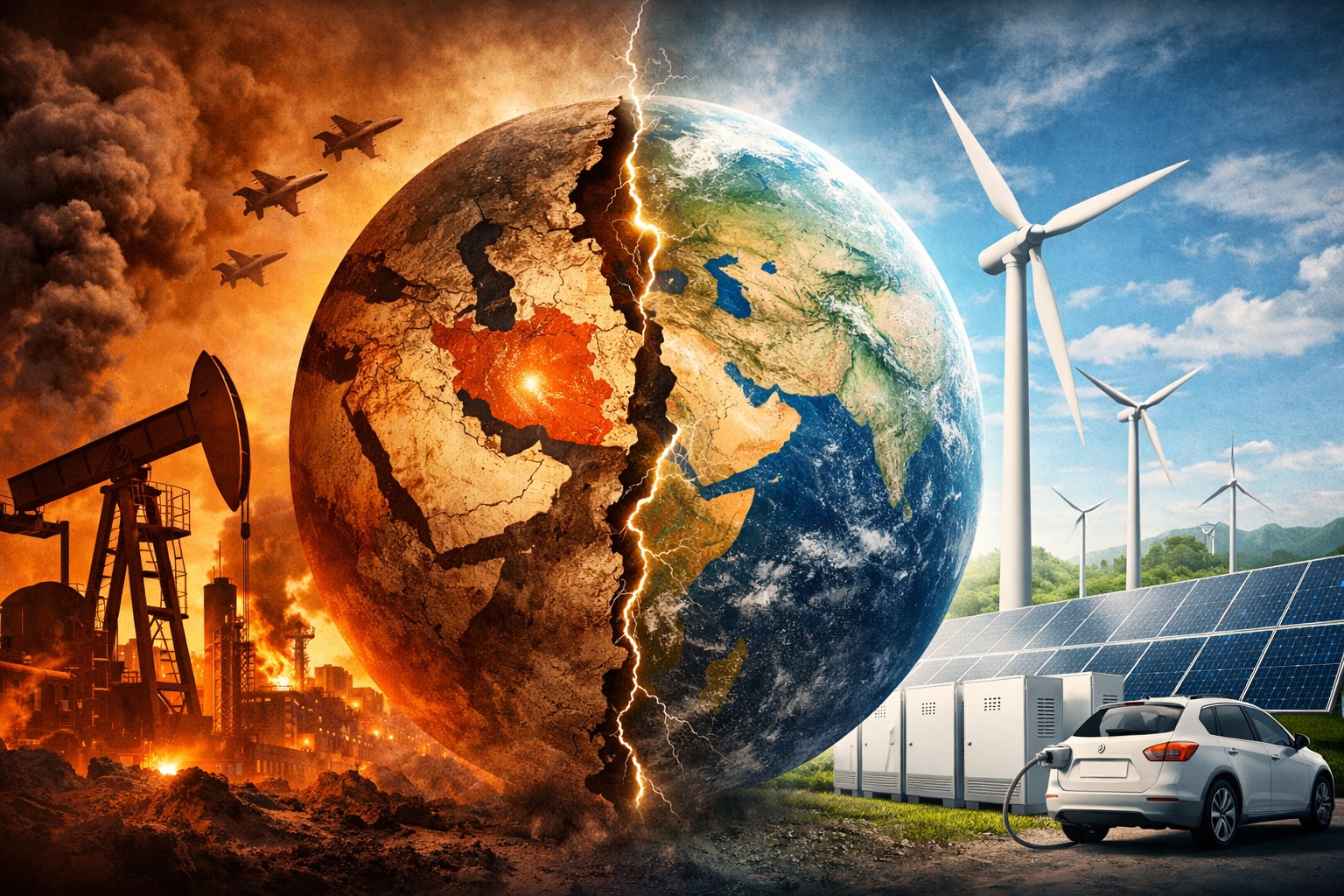
Energy transitions are often driven less by climate policy than by geopolitics. The tensions around Iran may become the next catalyst.
Energy history has a strange sense of irony.
The oil shocks of 1973 and 1979 reshaped the global energy system. What began as geopolitical crises quickly turned into structural transformations.
Governments around the world suddenly realized how vulnerable their economies were to oil supply disruptions. The response was profound: massive investments in nuclear power, accelerated electrification of rail transport, the first serious energy efficiency policies, and eventually the birth of the modern wind and solar industries.
Energy security became a strategic priority.
Today, half a century later, geopolitics may once again play a similar role.
Iran and the Return of Energy Security
The ongoing tensions around Iran are pushing energy security back to the center of the global economic debate.
Whenever instability threatens global oil supply, governments and markets react quickly. Prices move, risk premiums appear, and strategic vulnerabilities suddenly become visible.
But the situation today is fundamentally different from the 1970s.
Back then, alternatives to oil were still largely experimental or theoretical. Nuclear power was expanding, but most other solutions were still emerging technologies.
Today, the world has a full catalog of alternatives ready for deployment.
Solar and wind are now among the cheapest sources of electricity in many parts of the world. Batteries are scaling rapidly. Electric vehicles are becoming mainstream. Electrification technologies are spreading across transport, industry and buildings.
The key challenge is no longer invention. It is deployment at scale.
When Oil Becomes Risky, Economies Buy Less Oil
History shows that when oil becomes unstable or expensive, countries do not simply absorb the shock.
They adapt.
In the 1970s, this meant improving efficiency and diversifying energy systems.
If a similar dynamic unfolds today, the response will likely be different in form but similar in logic: countries will try to reduce structural dependence on oil.
In practice, that means accelerating investments in:
- Wind and solar generation
- Battery storage
- Electric vehicles
- Electrified public transport
- Electrification of buildings and industry
In other words, less oil demand over time.
A Geopolitical Irony
There is also a political irony in this moment.
Donald Trump has consistently positioned himself as a defender of the oil and gas industry, seeking to preserve its role in the global energy system and support domestic fossil fuel production.
Yet geopolitical tensions in the Middle East — particularly around Iran — could end up accelerating the very transition away from oil that he has spent years trying to slow down.
Energy markets respond to risk.
And when oil supply becomes uncertain, the most rational long-term strategy for many economies is simply to reduce exposure to oil altogether.
The Transition May Accelerate for Non-Climate Reasons
The energy transition is often framed as a climate policy project.
But historically, many of the largest transformations in energy systems have been driven by security and economic concerns rather than environmental ones.
The oil shocks of the 1970s were a clear example.
Today’s geopolitical tensions could once again push governments toward diversification and electrification — not primarily to reduce emissions, but to increase resilience and strategic autonomy.
The Human Reality Behind the Headlines
Of course, none of this should obscure the human cost of geopolitical conflict.
The Iranian population continues to face profound political and economic pressures, and instability in the region brings serious risks for the broader Middle East.
One can only hope that the current tensions de-escalate and that a path toward stability eventually emerges.
But from a structural perspective, history suggests that crises often reshape energy systems in ways that were not initially intended.
And once again, geopolitics may end up accelerating the global shift toward electricity, renewables, and energy independence.
#EnergyTransition #EnergySecurity #ClimateTech #Geopolitics #EnergyMarkets #RenewableEnergy #Electrification #Infrastructure