The United States may be witnessing an extraordinary sequence of three trillion-dollar-scale IPOs. SpaceX went public in June 2026 at a valuation of roughly $1.77 trillion. Anthropic is preparing a listing targeting around $1.3 trillion. OpenAI has filed for an IPO, with a trillion-dollar valuation discussed, although its timing and eventual price remain uncertain.
Meanwhile, China has secured commanding positions in solar power, electric vehicles and batteries, industries that will shape the coming decades.
And Europe?
After the dot-com bubble, Europe largely missed the rise of the American software and technology giants that became the Magnificent Seven. We had twenty years to rethink our innovation engine and prepare for the next big wave.
Yet the last six years have been sobering. Energy transition, electrification, artificial intelligence and now physical AI, where software operates robots, vehicles and industrial machines, have opened enormous new markets. Europe contributed science, engineering, talent and capital, but has struggled to create a comparable new generation of global leaders.
What makes the US so effective at building them? What enabled China to scale new industries? And what could Europe do differently?
1. The US does not simply fund companies.
It funds extraordinary possibilities. Silicon Valley's greatest advantage may not be its technology, universities or even its capital. It may be its culture. But culture is difficult to replicate. What exactly is that culture, and where does it come from?
At its core is a willingness to pursue opportunities that initially appear improbable, excessively ambitious or economically irrational. Reusable rockets, mass-market electric vehicles, artificial general intelligence: these were attempts to reshape industries, not incrementally improve them. Where that willingness comes from is the previous generation of companies. A successful cohort leaves behind people with the money, the scar tissue and the credibility to fund the next one before the opportunity is obvious.
Transformative ideas rarely begin with consensus. Most people judge what is possible through today's markets and assumptions. Great venture investors must sometimes recognize extraordinary potential when only a small minority sees it. That does not make every contrarian idea good. It means asking first whether the upside could be exceptional, then rigorously testing whether the people and technology can deliver it.
This is consistent with venture capital's power-law economics: a handful of winners may account for most of a portfolio's returns. The objective is not to maximize the percentage of startups that survive. It is to maximize the potential value created by the portfolio. Once everyone agrees that an opportunity is extraordinary, much of the advantage of recognizing it early may already have disappeared.
2. China understood the power of industrial scale.
China followed another path, combining industrial policy, infrastructure, financing, supply-chain integration, manufacturing capacity and intense domestic competition. Many ventures failed, and overcapacity carries real costs. Yet the result is globally competitive ecosystems in solar, batteries and electric vehicles.
The American and Chinese models differ profoundly. Both used the same strategic shape: a strong foothold and early growth in the domestic market, pursued at the same time as aggressive international expansion. Technology adoption in the United States was deep enough to turn domestic companies into global platforms. In China, clean-energy adoption and industrial ramp-up were massive, helped by sustained government policy, and solar, batteries and electric vehicles became export industries. Europe need not copy either model. The lesson is that a home market which actually adopts the new industry can become the base of an export machine.
3. Europe has strengths to build on, and habits to question.
Europe has exceptional universities, engineers, entrepreneurs, industrial capabilities and financial wealth. Its rigor and prudence are assets. But an ecosystem built primarily to control downside risk may overlook opportunities with extraordinary upside.
We often ask for commercial proof before committing major capital, and fragmented markets make scaling harder. If building a European company is structurally more difficult, should we not be ready to commit more capital rather than less?
Europe is not without remarkable entrepreneurial successes. Revolut reached a valuation of approximately $115 billion in a secondary share sale, and its chief executive has said he would prefer a primary listing in the United States. Mistral AI and Helsing, both legally headquartered in Europe, show that we can create globally relevant businesses in emerging industries. ElevenLabs and Lovable were built from Europe too. Their top legal entities are American, which is why a count based on European legal headquarters leaves them out.
Yet the difference in scale remains striking. The European AI Index of 7 October 2026 put the combined value of Europe's 15 largest privately held AI companies with European legal headquarters at $123.7 billion, about 14.5% of OpenAI's March 2026 valuation of $852 billion. These are not perfectly comparable populations, but the magnitude of the gap is difficult to ignore.
The Draghi report has clearly identified Europe's structural weaknesses. Initiatives such as EU Inc. seek to address them. But reforms take time, can be diluted or blocked by political negotiations, and technological revolutions do not wait.
If we cannot rapidly make Europe an easier place to build and scale a business, perhaps we must be prepared to compensate through sheer financial commitment.
This is not about throwing money at every startup. It is about concentrating substantially greater resources behind exceptional opportunities. Concentrate means the size of each check, not a single chosen winner: large checks into a small set of opportunities that still look unreasonable to most investors, with an explicit decision to stop when the assumption has been disproved. If European entrepreneurs must overcome more obstacles to reach global scale, why should we expect them to succeed with less capital?
We should reform the market wherever possible. But we cannot afford to wait for a perfect market before building the companies of tomorrow.
The next breakthrough might come from a PhD researcher spending years on an unfashionable hypothesis, a dropout from a top-tier college working in a garage, or a seasoned professional in their forties embarking on an entirely new entrepreneurial journey. None of these profiles guarantees success. Part of what has made the Bay Area effective is that divergent ideas, and divergent people, can be heard before they look respectable. Extraordinary ideas can emerge from unexpected places, at any stage of life.
Are we selecting entrepreneurs for their ability to create extraordinary companies, or for their ability to look like successful entrepreneurs?
4. Speed, venture-building skills and tolerance for failure matter.
Innovation is a competition against time as much as capital. In emerging industries, being five years late can be more expensive than being wrong five times.
Building a venture is not the same as managing an established business. Established firms optimize operations and execute plans. Ventures discover a business that does not yet exist. They must act with incomplete information, experiment quickly, tolerate ambiguity and accept some messiness, without abandoning discipline.
We teach people to run successful businesses. But where do we teach them to build businesses that do not yet exist? Fast experimentation and experienced venture builders are as important as funding.
And speed requires a sensible tolerance for failure. Not dishonesty, poor governance or endless subsidies, but a willingness to test, learn, stop and try again. A failed venture can leave behind skills, technologies and future founders. Punishing every failure as a personal disgrace makes ambitious experimentation less likely. A failed experiment can be productive if it produces learning quickly and cheaply. What becomes dangerous is spending years defending an assumption that reality has already disproved.
5. Industrial preservation is not venture creation.
Europe's corporate heritage is extraordinary: Volkswagen, Siemens, Schneider Electric and Airbus, as well as the GRANOLAS, the listed champions often compared with America's Magnificent Seven. Most of that group compounds healthcare and consumer businesses that already exist. ASML and SAP, the technology companies inside it, show that Europe can also build transformative technology leaders.
These companies must innovate and compete. But improving the industries we already have is not the same as creating the industries we do not yet have. Both are essential; they require different capital-allocation philosophies.
Let corporations improve the industries we have. Let venture builders create the industries we do not yet have.
6. Aim for trillions.
Create billions. Imagine Europe set out to create three trillion-euro companies over the next twenty years, and failed to reach that goal. We might still produce several businesses worth tens of billions, dozens of unicorns, hundreds of profitable companies and thousands of experienced entrepreneurs.
We could fail to create three trillion-euro companies and still achieve one of the greatest entrepreneurial successes in European history.
And investing big does not automatically mean wasting money. When ambitious ventures spend capital productively in Europe, it pays researchers, engineers and suppliers; finances equipment, laboratories and factories; and builds expertise and intellectual property. Those activities can support employment, growth and tax receipts long before an IPO. If the resulting companies export globally, the long-term gains can be much larger.
Of course, spending is not itself a return. Some capital leaks abroad, some projects displace other activity and some investments create little lasting value. The case for large-scale investment is strongest when it builds productive capabilities and internationally competitive businesses. But the alternative has a cost too: chronic underinvestment can mean missing entire markets, future exports, skills and tax bases for decades. The cost of doing too little may exceed the cost of well-managed attempts that fail. A venture can fail financially while leaving behind technologies, experienced people, productive capacity and new businesses that benefit the wider economy. The relevant question is not simply how much capital we risk losing by investing, but how much future value we risk forfeiting by not investing.
To finance that ambition, Europe needs a capital-allocation machine. In 2006, NASA awarded SpaceX a $278 million development agreement before it had reached orbit. In 2010, the US Department of Energy finalized a $465 million loan to help Tesla scale electric-vehicle manufacturing. In 2019, Microsoft committed $1 billion to OpenAI, years before ChatGPT reached mass adoption. These were development funding, government lending and strategic corporate investment, not identical instruments or ordinary VC checks. They show how public agencies and major corporations can commit exceptional resources before commercial success at scale is assured. Sustained commitment is still not a blank check: stop when reality has disproved the assumption.
Europe has more often failed for lack of that kind of commitment than from an excess of it. Solar and electric vehicles were started, slowed and reopened. Too often the disruption was left to the incumbents it threatened, who then handled it at the pace of the business it was meant to replace. The European habit has been different, withdrawing support from a direction that was still working each time the consensus shifted.
Europe is not short of savings. Savings become risk capital only when mandates, time horizons and career risk allow the people who control them to be wrong. But can its investors, institutions and corporations mobilize large amounts of patient, risk-bearing capital quickly, and continue backing the best European ventures as they scale from millions to billions?
The returns also compound through people. Employee equity can turn early team members into financially independent founders, angel investors and venture capitalists. The liquidity created by major American technology successes can release an entire generation of experienced builders to finance and launch the next wave.
The US does not merely create today's leaders. It strengthens its starting position for the next generation. That is how the willingness to back improbable ideas gets reproduced: employee equity and a real liquidity event turn one cohort of builders into the angels and investors of the next. Europe needs its own entrepreneurial flywheel. When founders, employees and investors remain concentrated in the same ecosystem, their wealth, experience and networks give the next generation a head start.
7. Change the question.
Europe should continue addressing regulation, market fragmentation and funding gaps. But those are means, not the destination.
What new industries could Europe create and lead over the next twenty years? Not merely participate in, regulate or supply components to. Lead.
What if we began with opportunities worth trillions and worked backwards to identify the ideas, talent, institutions, capital and speed required to pursue them?
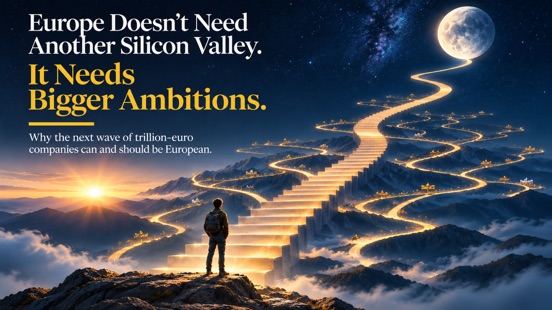
Ambition is an economic choice.
Europe does not need to become another Silicon Valley, nor blindly imitate China. It has its own strengths and values. But we should stop confusing prudence with limited ambition.
We have spent too much time asking how to reduce the risks of entrepreneurship and too little asking how to increase its potential rewards.
Ambition is not the opposite of economic rationality. When combined with rigorous selection, speed, effective capital allocation and the recycling of entrepreneurial wealth and experience, ambition can become a powerful engine of long-term economic growth.
Culture follows incentives. Incentives follow opportunities. And opportunities begin with ambition.
The question is not whether Europe can afford to think bigger. It is whether we can afford another twenty years of thinking too small.
Factual references: SpaceX IPO pricing announcement, June 11, 2026; Reuters on Anthropic IPO, November 2026, and OpenAI filing, June 2026; Built in EU, European AI Index 2026, updated 7 October 2026, compared with OpenAI's March 2026 round; Revolut secondary sale, November 2026, and Nik Storonsky on a preferred US primary listing, Bloomberg, October 2026; Goldman Sachs GRANOLAS list, 2020; NASA COTS award (2006); US Department of Energy Tesla loan (2010); Microsoft–OpenAI partnership announcement (2019). IPO valuations and future listings are not guaranteed.
#Europe #Innovation #VentureCapital #Entrepreneurship #Startups #DeepTech #IndustrialPolicy #EconomicGrowth #ArtificialIntelligence #Ambition